
Rail Brake Disc Case Study
We entered a competition to design a brake disc for a train with better heat dissipation than the standard part. The brief was to model the disc in CAD, explain its features and benefits, and present the concept to a jury who would choose the strongest shape and use case.
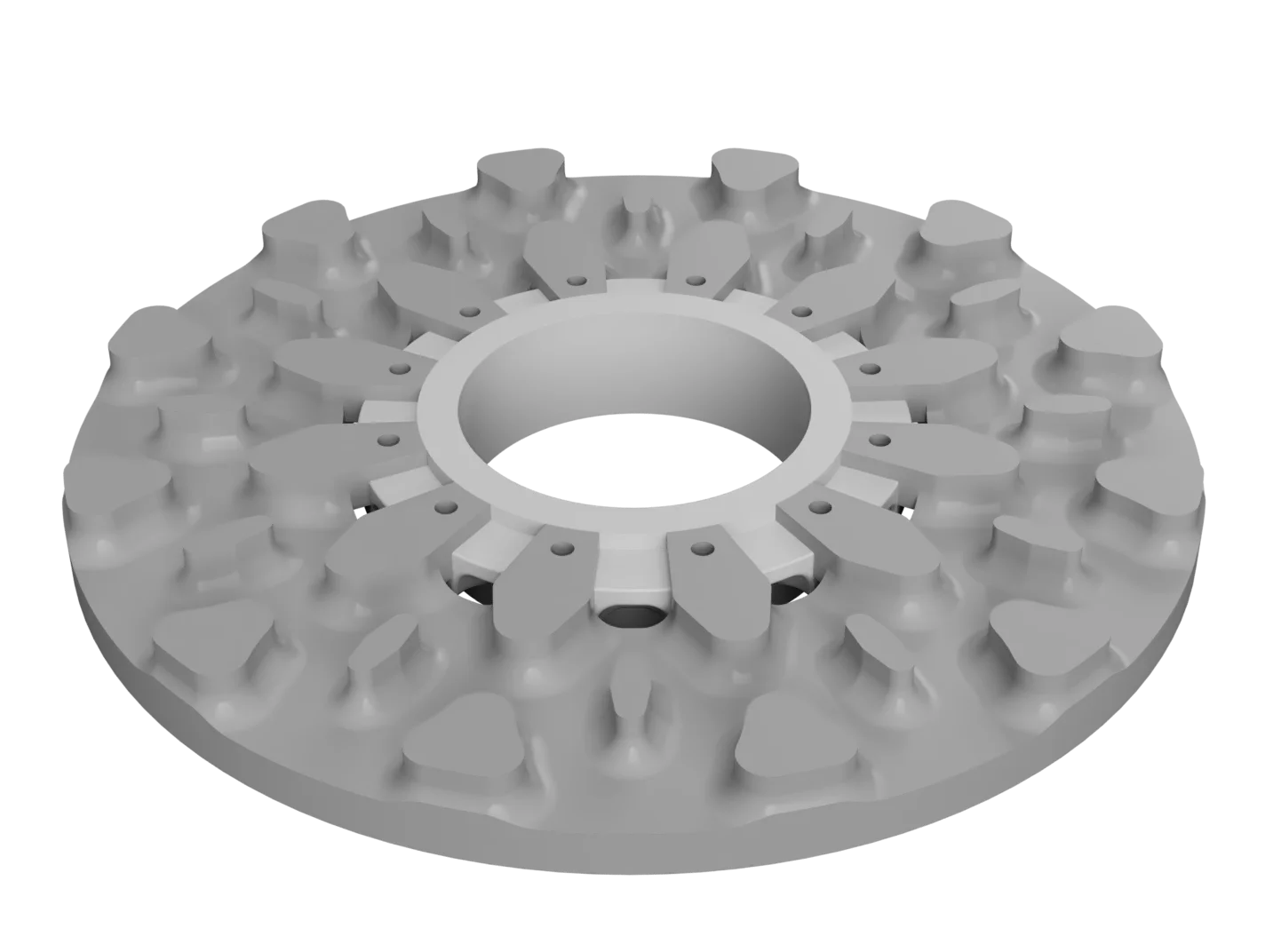
A disc that breathes
Our entry is a double-walled disc. Air is drawn in through openings near the axis, passes through internal pins that greatly increase the internal surface area, and exits around the circumference. The wheel's own rotation sets up a pressure difference between the hub and the rim, which is designed to encourage air to flow through the disc as it spins, cooling it from the inside rather than relying on the outer face alone.
Presenting the concept
Alongside the CAD model we prepared the reasoning and visuals to make the case to the jury: how the internal geometry adds surface area, why the pressure difference moves air through it, and where the design would earn its keep in service.
The challenge
A brake disc lives or dies on how quickly it sheds heat. Rather than simply adding external fins, we treated the disc as a pump: use the rotation it already has to move cooling air through an enlarged internal surface, so the part helps to cool itself.